Wednesday, August 29, 2012

Kitties!!! And other cuteness...

It's late.  I'm tired.  My kitchen is sweltering, but I have 7 pints of diced tomatoes and 4 pints of tomato sauce cooling on the counter.  It was worth it.  These will be added to my growing collection of canned goods in the basement.

Things have been busy around here.  There is the harvest to deal with of course and all the animal-related chores, but we're also in the midst of a kitchen remodel (I know, poor timing to remodel at the height of canning season, but we needed to sand and refinish the floor while the weather was nice).  Add that on top of all the back-to-school activity and you have a recipe for one tired family.  I actually find myself dreaming about winter and hibernation...

There are a million blog post ideas running around in my head, but by the time I get a chance to sit down at the computer each night, my brain is fried and I can barely form coherent thoughts.  Sooooooo... I'm going to entertain you with cute pictures of kids and kittens, and hope it distracts you from realizing that this post is about, well.... nothing.


Here is my daughter helping me fill the water troughs for the animals.  Yes, she wears those boots around all day.  And yes, it's adorable.


Big Helper


Our barn cat Harriet had 6 kittens in May.  When they were about 3-4 weeks old, three of them disappeared one day, even though they still could not crawl.  We're not sure what happened to them... perhaps Harriet knew she could not feed 6 babies and removed them from the nest.  We now have Harriet and her three remaining kittens as our barn cats.  Judging from the dead mice and voles they leave on the barn floor, I would say they are doing a good job. 


Lucy 2, Grayson, Harriet and Tiger


My daughter adores the barn kitties.  I do believe she would spend the whole day out there with them if she could.  For some reason, the kittens don't mind being held by her.  They run away from most other people, but she seems to have the touch.  I call her "The Kitten Whisperer".


"The Kitten Whisperer"


Snuggling with Grayson (who used to be named "Gracie" until we discovered "she" was a "he")


My sweet boy turned six years old in August.  SIX!!!  How did this happen?!?  We had a small birthday party outdoors and I was once again reminded that we should really lock up the chickens for the day when we are hosting a party.  Silly Phylis. At least she drank out of my water, and not one our guest's. 


Guess I won't be drinking out of that cup anymore...


As summer comes to end, school begins.  My dear son started kindergarten yesterday.  I made him pose in front of the tree for his annual "first-day-of-school" photo.  The kid has been losing teeth left and right, and I can't get enough of his toothy (lack of toothy?) grin.  It makes me smile every time!


"Jack-O-Lantern" grin

In other news, Bruce the rooster is no more.  He attacked my daughter one morning while we were doing chores and I decided that was the final straw.  We butchered him that same evening.  That's what he gets for not playing nice.  Once he was gone, there was a collective sigh of relief on the farm.  No more crowing at all hours day and night (he woke me up crowing at 3am once).  No more harassed chickens.  The poor ladies were getting desperate.  I watched a few of them even play dead so Bruce would leave them alone (he would only chase a moving target).  Maybe we'll try having a rooster at another time, but for now, I say good riddance.  He will make excellent chicken soup (rooster soup?). 


Bruce
 
 
Thanks to all of you who have been over to visit.  It's been a delightful distraction!  I don't get out much, with all the work to be done around here, so I really appreciate people coming to visit me.  And of course, if you visit, be sure to bring a bag, because I WILL be sending you home with tomatoes.  Good night, all.

Tuesday, August 14, 2012

"I got worms."

"I beg your pardon?" 
"That's what we're gonna call it.  I got worms!   We're gonna specialize in selling worm farms. You know, like ant farms."


Little did I know that Lloyd (from the movie "Dumb and Dumber") was actually onto something.  Worm farms.  Huh. 

The day we moved into our new home was a cold, miserable day.  Our good friends Maribeth and Eric were kind enough to help us move our belonging on that drizzly March day.  After everything had been unloaded, they presented us with our first housewarming gift.  It was a gift like no other! 

Our dear friends, who know us so well, gifted us with a huge bin full of worms and rotten produce.  I was so excited I could hardly stand it! Seriously.  A worm farm!!!   Best housewarming gift EVER (but I would recommend that you know your audience before you present this a gift.  Ha!).   I had done a wee bit of research on "vermicomposting" (the fancy name for worm farming/composting), but didn't have the time or resources to follow through. 

If you already compost your kitchen scraps and are interested in producing wonderful *free* fertilizer for your house plants and garden, then perhaps vermicomposting is for you!  Anyone can vermicompost.  Doesn't matter if you live in a tiny apartment or have acres to roam.  You can be as serious about it or relaxed as you want to be (I know from personal experience that you can completely neglect your worms for over 6 months... and they will still be [mostly] fine.  Sorry little buddies.).  Vermicomposting is especially fun to try with kids - they delight in seeing those wiggling worms.  Last week, at the library, we actually stumbled across this book in the children's section, called "Winnie Finn, Worm Farmer" by Carol Brendler.  What a fun book to introduce children to the concepts of worm farming!  I may or may not have enjoyed the book more than my kids :)


A fun book about vermicomposting to read with the kids! 
"Winnie Finn, Worm Farmer" by Carol Brendler


Here is the quick lowdown on vermicomposting:

1. You create a container to hold the worms.
2. You feed the worms a combination of kitchen scraps, newspaper, yard waste, etc.
3. The worms will digest the scraps and create two by-products: Worm Tea (liquid fertilizer) and Worm Castings (a.k.a. Worm Poop).
4. Add Tea or Castings to your plants and watch them thrive!


Let me show you how my worn bin/container works.  First, you need two Rubbermaid type storage containers, one lid, two bricks or pieces of lumber, and a power drill with a bit smaller than 1/8 inch.  You can decide how large or small you want the container to be.  Once you have chosen your bin size, place the two bricks in the bottom of the first bin. These bricks will allow liquid worm tea to drain from the top bin into the lower bin.   Next, use the drill to make holes in the sides and bottom of the second bin.  Also make holes in the lid.  The holes will provide ventilation (from sides and top) and drainage (from the bottom).  The bin with the holes nests inside the first/lower bin, raised up by the bricks.  The lid goes on top of the bin with the holes.   


The worm bin - two containers, the one with air/drainage holes nested inside the solid bin.


Air holes in the worm bin - drill them in the lid, the sides and the bottom.


Now you are ready to get your hands on some worms!  Red Wiggler worms are the most desired worms for vermicomposting.  In a pinch, I believe you could go purchase some red wigglers from a bait shop, but most folks order their worms on-line.  Uncle Jim's Worm Farm is a popular site (Bonus!  They have worms on summer sale right now!).  They will ship your package of wiggly worms right to your door.

Once you have your worms, you need to create a "bed" for them, using shredded newspaper, cardboard, wood shavings, etc.  Keep this bedding moist.  Now it's time to feed them!   There are LOTS of different opinions on exactly what you can feed your worms.  Good candidates for the worm box are fruit and veggie scraps, coffee grounds, eggshells, leaves or house plant trimmings, and the like .  Make sure you give them a good mix of carbon (brown, dead stuff such as newspaper, cardboard, leaves, etc) and nitrogen (green, live stuff such as kitchen and garden scraps). 


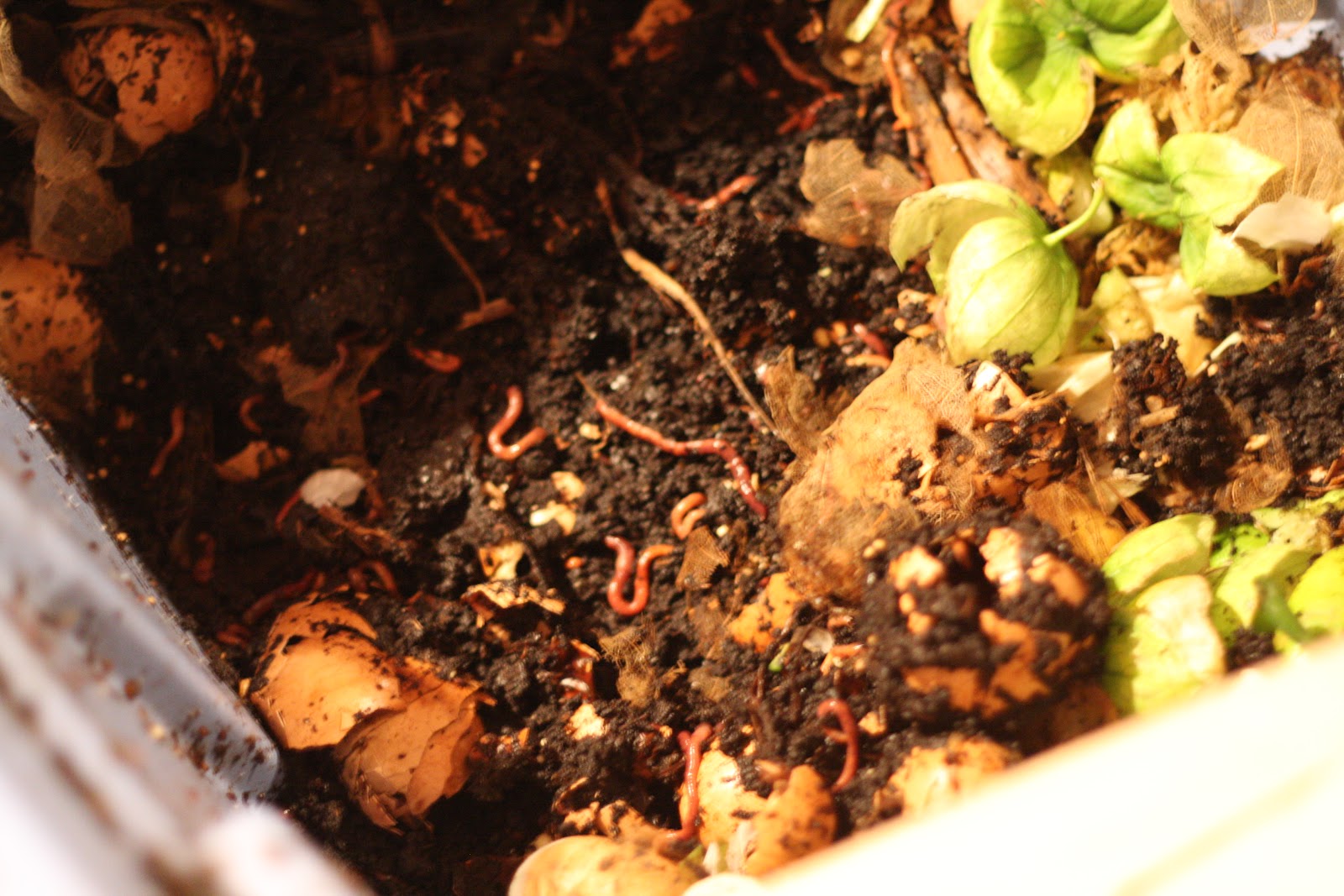
Worms and scraps inside my worm bin.  All the black stuff is worm castings (poo).  My bin is a little too wet right now.  I should add more carbon (newspaper, cardboard, leaves, etc.) and  remove some of the castings.


After a while, pull the bins apart and see if your worms have produced any worm tea.  This stuff is liquid gold!  Pour it into a container and add some to your watering can when it's time to water plants.  You can also harvest the worm castings, but I have not embarked on that adventure yet, so I have no advice.  I believe it involves moving all the castings to one side of the box and putting all the new bedding and food on the other side.  The worms will eventually migrate to the food, leaving the pile of castings behind for you to harvest.  These castings are incredible to add to your potting soil mix or sprinkle in your garden.


 Pull the top bin out and check to see how much worm tea is in the bottom bin


This is a just a quick peek into how we do it over here. I am no expert on worm farming, so make sure you do some research on your own.  There are several great on-line resources, including this site here.  I found it to be enormously helpful!

So how much produce/scraps can your worms eat?  Well, that depends on several factors, but I've read that a pound of worms can eat about a pound of food a day.  How does one measure how many worms they have, you ask?  I don't know.  I simply keep adding feed until they can't keep up and then let them work uninterrupted for a week or two. Since we have chickens, hogs and a cow, most of our scraps go to them.   However, during the winter months, I often find it easier to carry the scraps downstairs, instead of trudging out to the barn in the snow.  Our worm bin certainly can't consume all of our scraps, but they can handle a good amount, especially things like jalapeno pepper scraps, which the animals don't care to eat. 

Worm farming is fun and it's always enjoyable to see the looks of disbelief of people's faces when you tell them you have a huge container of worms in your basement.  It's quite the conversation starter.  Apparently Lloyd was not so "dumb" - worm farms really are a good idea!


Friday, August 10, 2012

Be careful what you wish for...

Fresh juicy tomatoes. Intoxicating basil.  Crunchy cucumbers.  Sweet onions.  Delicious snap beans.  Beautiful bell peppers.  Spicy jalapenos.  Melt-in-your-mouth sweet corn.  Crisp carrots. 

THIS is why we garden.  You've heard it a million times, but there really is nothing quite as tasty as veggies you have grown in your own backyard.  Sweet corn goes from "Yummy" to sublime when it's picked just minutes before you eat it.  Tomatoes are irresistible, even for someone like me, who is not a huge fan of them (but I'm quickly changing my mind - heirloom varieties like "Brandywine" and "Cherokee Purple" are out of this world!).  So many tastes and flavors bursting with freshness.... it's a sensory overload.  THIS is what we dream about all winter long.  We are living the dream right now, gardening friends!


Harvesting tomatoes, with Cooper (former art students - yes, I still wear an apron all day.  Ha!).  Look how tall my tomatoes are!  Goat compost is magical stuff, I tell you.


Oh, I know.... it's not all dreamy.  There are tomato hornworms to deal with, blossom end rot, cucumber beetles, birds eating my sweet corn, the crippling drought, and all manner of annoying, icky things.  However, being the optimist that I am, I like to forget about all that stuff and just enjoy the good. 

 The garden is reaching it's apex and I've been busier that ever, scurrying and rushing to harvest and preserve the bounty.  My days consist of harvesting, canning, freezing, dehydrating, dishes, dishes and more dishes.  Food is all consuming. Since I'm new at preserving and don't have any "tried and true" recipes, hours are spent researching preserving methods/recipes.  I spend almost all of my waking hours contemplating food, between cooking all the meals for my family and preserving.  Some days, it gets old, and I wish I could just do things that normal people do, such as, oh you know, sit down (thank you Mom for the rubber chef's floor mat - it's a lifesaver!).  Go to the park and relax .  Go shopping for more things that I don't really need.  Then I remember that what I'm doing is normal - I'm growing my own food and preserving it so I can feed my family over the winter.  In a basic sense, I'm doing what people have been doing for thousands of years.  And no matter how tired or defeated I feel, it never fails to thrill me when I see those beautiful jars lined up in the basement, the freezer packed full of produce.  It's inspiring.

As the year progresses, I have a renewed appreciation for seasonality.  Summer is busy, a flurry of activity.  Winter is for relaxing, for resting and refreshing.  I'm looking forward to that period of rest right now, just as I was looking forward to the flurry of activity last winter.   The rhythms of the year are comforting... when I am bone-weary, I know that summer won't last forever.  Respite is coming.  And just when I can't take any more of winter, spring will arrive in all it's glory, so we can do it all over again.


Half of the day's garden haul

We have produce coming out our ears.  Some days, it's overwhelming.  Why did I plant so much?  What am I going to DO with all of this?  And then I remember, I asked God for this.  When we were searching for Third Day Farms, I kept praying desperately that God would provide a place for us, a place full of bounty so that we could be a blessing to others.  Be careful what you wish for!  We've got bounty all right.  Now, I'm trying to figure out how to bless others with it.  Some days, as I work in my kitchen for hours on end, I wonder how I am blessing others by holing myself up in the kitchen.  Is all this time spent focused on food what God wants me to be doing?  How can I be bringing God's kingdom to earth when I'm stuck in my kitchen all day?

And then the people stop by.  Lately, we've been averaging 1-2 visitors a day (and I LOVE it).   So THIS is how He wants me to bless others!  My visitors seldom go away empty handed.  There is always produce to send home with them, perhaps a jar of pickles, some jam, or a pint of berries.  All those hours toiling in the kitchen and garden?  They now have purpose.  That long afternoon laboring over tomato basil sauce?  Perhaps that will become a gift to someone in need or used to make a dinner for a family with a new baby.  This is my calling right now, and I'm doing my best to follow God's leading, as He teaches me the joy of giving. 

There is also the stewardship issue - I want to do my best to care for and use all the gifts that God has blessed me with.  It seems like a shame to let anything go to waste.  He gave me this bounty for a reason - now it's up to me to be a responsible steward of this great gift.  Thankfully, we have 3 pig hungry pigs and a cow in the backyard that are more  than willing to help take care of any extra produce that lays around too long.  I don't feel bad about giving it to them - they're converting that "waste" into delicious meat. 

So what exactly have I been laboring over?  Mostly tomatoes.  Remember those 45 tomato plants I planted in May?  Well, almost all of them have done exceptionally well!  We started getting a steady stream of tomatoes in early July and things have not slowed down since.  I've canned a few batches and made a batch of tomato basil sauce, but mostly I've been freezing them whole (cut out the stem and flash freeze on a cookie sheet before dumping into freezer bags) so I don't have to think about them right now.  I'll dig out those bags come winter and cook down the tomatoes for sauce or tomato soup.  We've given away about half of the tomatoes - no one seems to turn down fresh tomatoes, especially those to-die-for "Brandywines". 


We get this many tomatoes about every other day.

 
My pickling cucumbers went bonkers and before I knew it, there were 24 quarts and 6 pints of pickles in the basement... not counting all the jars I gave away.  We like pickles around here, but I'm not sure if we can eat that many.  Family members beware:  you may be receiving a jar of pickles for Christmas. 

Snap beans were planted a bit late this year, so we're just starting to get a harvest.  A rather disappointing harvest.  Perhaps it was the drought.  Maybe it was the spider mite infestation.  I'm not sure, but I do know that we're not getting many.  In the garden at my old house, I could fill a big colander every other day from my 1 row of beans.  Here, I'm just getting a handful of beans each day, despite the fact that I have 4 rows of beans.  I have "Blue Lake" pole beans, "Pencil Pod" yellow wax beans, and "Royal Burgundy" snap beans.  The "Blue Lake" pole beans are my favorite (did I mention I hate bending over to pick bush beans?).  My little experiment of growing pole beans on sunflowers seemed to work, but I wonder if the sunflower leaves shade the bean plants too much?  Next year, I'll experiment more. 


A variety of snap beans


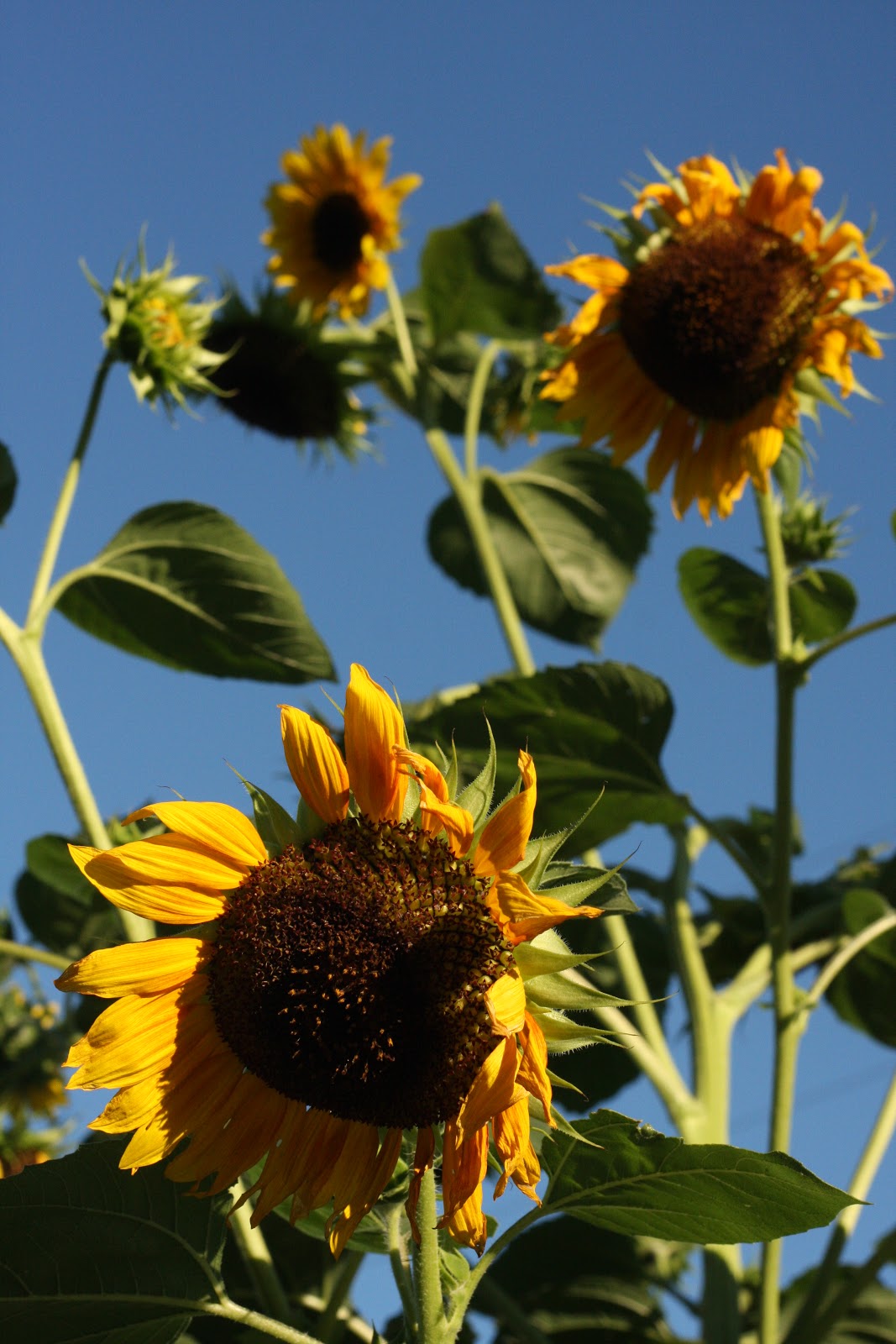
The flowers I planted throughout the garden are thriving and seem to be attracting a multitude of pollinators.   When I walk in the garden, I can hear a low buzz of bees and wasps at work.  Several of them are my honey bees, but most of them are insect species I have never seen before.  It's fun to watch!  The sunflowers are especially beautiful and cheer up the whole house when we make cut flower arrangements.  We're going to try saving the seeds and roasting them. 


Sunflowers

 
Yesterday, my son and I pulled up the onions.  Their tops had fallen over, the signal that they are ready.  We left them in the garden to dry and cure.  In a week or so, they will be ready for storage.  I wish I had planted more.  They look great and smell ever better!


"Cortland" and "Rossi di Milano" onions


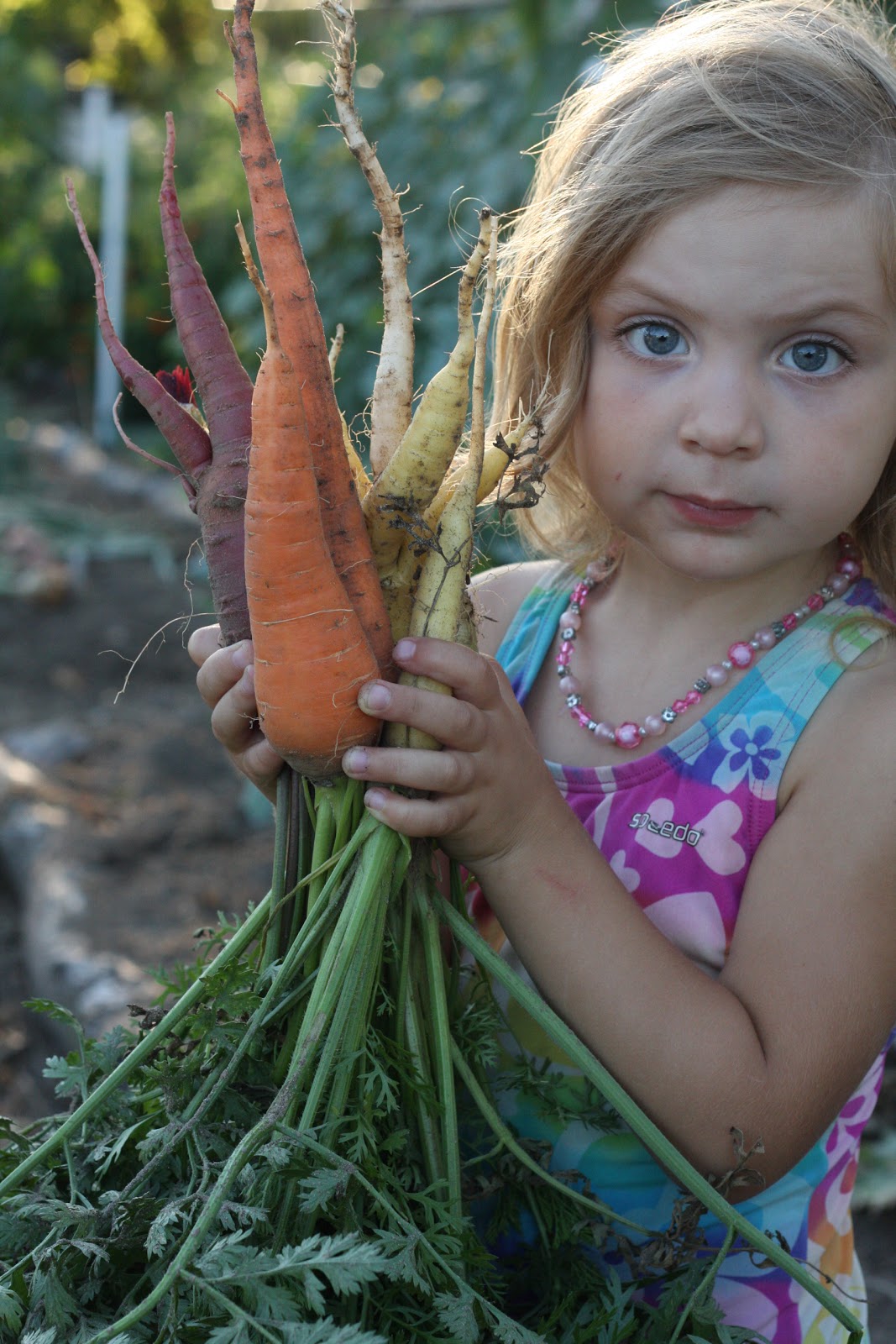
I made the mistake of ignoring the carrots - they were doing so nicely and didn't need me fussing over them.  By the time I went to pull them, some were over sized and bitter.  Babette the cow was more than willing to take care of them for me!  We still made out with many good carrots.  I dehydrated a bunch of them and plan on throwing them into soups and stews this winter.  I may freeze some as well, but we're going to try storing most of them in our basement.  Our basement is old (1880's) and there are some cool damp corners that would work well for long term storage.  We plan on trying the "carrots in a bucket of damp sand" method.  Hope it works!


My daughter holding a variety of carrots.  Such a good little helper!

 
Oh, there are more things that we are harvesting right now - sweet corn, celery, sweet peppers, hot peppers, tomatillos, basil, lemon cucumbers, watermelons - but I've bored you enough.  Stop by and see us!  Remember to bring a bag to take home some goodies.  

Thursday, August 2, 2012

Chicken Butchering

* Disclaimer:  This post is not for people who believe that meat animals are magically transformed into neatly wrapped packages that end up in the refrigerated section of the grocery store.  If you are a "boneless, skinless chicken breast only" type of person and get grossed out at the thought of your meat having bones and skin, then you don't want to keep reading.  You've been warned!


Ahhh, chicken butchering....  Somehow, by performing this act, I feel like I've crossed the line from "organic, eco, green, foodie" person into real-deal "homesteader" territory.  Not too many years ago, you would have not caught me dead even considering  butchering an animal.  No siree, not me.  My meat came for the shiny clean grocery store in nice little packages, requiring me only to heat it up.  Heck, I didn't even have to touch it - just dump the individually frozen piece of meat from the bag into the pan or baking dish.  The thought of cooking a whole chicken, with all the parts intact, left me feeling queasy.  Why on earth would I want to be reminded that I was eating an animal that had at one time been a living, breathing creature? 

I've come a long way since those years. When I pondered my relationship (or lack of) with meat, I never considered going vegetarian, but completely respect those who do, for their various reasons.  However, I did start to examine the implications of eating meat and didn't like what I discovered.  Most of us of are far removed from our food sources these days.  We have no idea where it comes from, how it was raised, how it ended up on our dinner table.  We take meat for granted, rarely stopping to think about how costly it is (financially and emotionally).  I began to realize that there is a certain sacredness and spirituality to eating meat - in order for us to live, something else has to die (sound familiar, those of you that are Christ-followers?). All eating requires sacrifice.  Now this extends to plant life too, as cutting a head of lettuce from the ground is akin to slitting the throat of an animal, but the imagery is more powerful when you are talking about a breathing, moving animal.  I remember hearing my dad, the biology teacher, say more than a few times that "nature is all about sex and violence".  Truer words have never been spoken.  Even the "gentle" plant world is full of sex and violence.  Life (and eating) is violent.  Sorry Alicia Silverstone, there is no such thing as "kind diet".

Eventually, I came to the conclusion that if I wanted to continue consuming meat,  I needed to make sure I was being a responsible and respectful omnivore.  I found this book, "The Compassionate Carnivore" by Catherine Friend to be helpful and entertaining guide. We also came to the decision that we simply could not buy meat from the grocery store anymore.   My husband and I began in earnest to seek out meat from animals that had been raised in a manner that we valued - preferably animals that were grass-fed (in the case of beef) and pastured (in the case of chicken and pork), no antibiotics (except when needed for a sick or injured animal), fed chemical free feed, and no hormones.  And what we discovered was that while it was fairly easy to locate a source for grass-fed beef (we buy ours from Karin and John, owners of Woodbridge Dairy Farm), finding "happy" chickens was a real challenge!  


Up until our big chicken butcher, I had been buying whole chickens at Byron Center Meats, which are labeled under the "local" section.  When we pressed them about how the chickens were raised, all we could find out was that the chickens are raised on an Amish farm near Muskegon, MI.  I wanted to know more, but figured buying the chicken there (supporting a local farm and a local butcher shop) was better than buying at the grocery store.  My quest for happy chickens continued.  I came to the conclusion that my husband and I were simply going to have to raise our own meat birds and butcher them ourselves.  However, the thought of adding another project to this year totally overwhelmed me.  Since May, we have installed a 4,000+ sq ft garden, started a small orchard, fenced in two acres for a cow and 2 goats, bought 3 hogs to raise for meat, raised 12 new chickens to add to our existing flock, bought 2 beehives to maintain.... what else am I forgetting?  Oh yeah, a kitchen remodel.  Anyway, the point is, we're exhausted and over extended.  Adding meat birds to the mix just wasn't going to happen. 

So imagine our excitement when our like-minded, wanna-be farmer friends, Dan and Katie, announced that they were going to be raising meat birds this year!  I eagerly volunteered us to help out on butchering day, figuring it would be a good chance to see how much work butchering is, so we could decide if we wanted to do it ourselves.  Also, we had an adopted laying hen, which the kids named Sweetie, that was getting old ( I think she was at least 5 years old) and not laying well anymore, so it was time to cull her from the flock.  She will be turned into soup/stew meat,as I hear that old hens are quite tough.


Sweetie, our old laying hen, waiting her turn
 

We started early, meeting at 6am on beautiful summer morning.  45 meat birds, a breed called Freedom Rangers, were milling about in the barn, blissfully unaware of their fate.  We had about 6-9 people working throughout the day (some people had to come late/leave early).  After coffee and chit-chat we started to get down to business.  Now, let me be clear.  Most of us had no idea what we were doing.  Oh, a few of us had butchered animals before and Dan had even butchered a few of the meat birds (one broke a leg and had to be taken care of), but this was mostly uncharted territory for us.  With the aid of a few YouTube videos (what can't you learn on YouTube?!?) and my trusty book "The Small-Scale Poultry Flock" by Harvey Ussery at our side (the book includes very precise step-by-step butchering instructions with clear photos), we plunged right in.


Step One:  Retrieve chickens.  Dan would head to the back room in the barn and grab a few birds at a time to bring to the slaughter area, keeping the other birds out of view of the slaughter.  This helped to keep the chickens as stress-free as possible. The birds had been on pasture for much of their lives, but were moved into the barn a few days before slaughter to make retrival easier.   Here are the Freedom Ranger birds waiting their turn. I believe the birds were around 10 weeks old and most dressed out at around 3-5 pounds when we finished with them.


Freedom Ranger chickens


Step Two:  The slaughter.  There are several ways to slaughter a chicken, including the classic "head on the chopping block" method.  And yes, a chicken will run around with it's head cut off.  Since we were not too keen on witnessing that, Dan opted for the "killing cone" method (I wish they could come up with a better name for it).  The chickens are placed head first into an upside down cone.  As soon as they are put in the cone, they become very calm and relaxed.  Their throats are quickly slit and the chicken is allowed to bleed out for a few minutes.  The cone keeps the chicken from flopping about.


Chicken in the killing cone ready to be slaughtered


Step Three:  Loosen feathers.  All those lovely feathers must come off.  Dipping the (dead) chicken in hot, but not boiling, water for about 30-60 seconds makes the feathers pull out easily.  We used a turkey fryer filled with water to dunk the birds. 


Loosening the feathers in hot water


Step 4:  Pluck the feathers.  Some people choose to pluck their chickens by hand, but since we were doing 45 birds at one time, my husband decided to get creative and design his very own chicken plucker (he's a handy one!  I think I'll keep him).  The book "Mini Farming: Self Sufficiency on 1/4 Acre" by Brett L. Markham has a good plucker design, with instructions on how to build it, as well as a parts list.  After studying this design and watching several YouTube videos displaying various plucker styles, John built this plucker featured below.  I won't go into all the details (because I don't know how he built it - I'll make him do a guest post to explain it), but let's just say it worked great!!!!  The white PVC drum spins and has little rubber "fingers" that grab the feathers and fling them to the ground.  We were able to remove most the feathers in this manner.  There was still some hand plucking to do, but the plucker saved us hours of work.


The "Pluck-O-Matic 3000", as we dubbed it


Step 5: Eviscerate.  I won't go into detail about this part.  If you want to know more, then get "The Small Scale Poultry Flock" book and study that.  Basically, it goes like this - cut off head and neck.  Cut off legs at the joint.  Remove oil sac from base of tail.  Lay chicken on it's back and cut slit into abdomen.  Reach into slit with your whole hand and scoop out the entrails.  Done. 


Chicken feet


Step 6:  Wash and package.  After evisceration, the birds were hosed off outside.  Then we whisked them into the house and they were dunked into a sink of cold water with a tiny splash of bleach to kill any bacteria.  After another thorough rinse with plain water, they were bagged, weighed and set in the fridge to chill. 


It took us about 5 hours to butcher 45 birds.  Not bad for a bunch of beginners.  Since it was the first time for most of us, there was a definite learning curve.  Also, I think the process took longer because we didn't have specific stations or duties. Most of us wanted to try each station a few times, so we could master the skills required.  Next time, I suspect we will assign stations to make the whole process run more smoothly. 

Surprisingly, it was a very fun day.  I would never say that killing animals is fun, but being with like-minded people, working towards a common goal, is fun.  At one point, Dan laughed and said something along the lines of, "This is awesome, to see all these other people who are willing to help out and want to be here. It almost makes me feel like I'm normal".   And of course I piped up, "You need to read Joel Salatin's book, "Folks, This ain't normal". According to him, we are normal! We want to know where our food comes from. That's normal!"


John and Nate at the butcher table


As payment for our labor, Dan and Katie gave us with a few chickens to take home for our freezer.  We were thrilled with this arrangement!  I'll work for food any day.  After purchasing a few more from them as well, our freezer is stocked with enough chicken to last us at least half a year. My search for "happy" chickens is complete. 


John and I have decided that we are going to try raising our own meat birds next summer. Let us know if you want to help butcher.  We'll pay you in chicken.

Tuesday, July 24, 2012

Whirlwind Farm Tour

First off, I want to thank all of you for hanging in there with me.  My brain is overflowing with topics, thoughts and ideas, but I simply cannot for the life of me find time to write regularly.  It's almost like I'm trying to run a household, cook all our meals from scratch, raise two small children, tend and harvest and preserve the bounty from a 4000+ sq foot garden, and care for 33 animals.  All at the same time :)  Let's just say we're a little swamped right now. 

I've been meaning to update the blog about various events that have occurred in the last month or so, but just ran out of time.  So here is a whirlwind update, by subject matter.


Garden: I don't mean to brag, but the garden is awesome!!!!  I'm absolutely thrilled with it.  Somehow, it turned out better than I could have ever dreamed.  Oh, of course, it's not perfect.  I have some insect pest issues ( I discovered a bunch of tomato hornworms on my tomatoes, potatoes and tomatillos. ICK!!) and some tomato plants are dying of a bacterial wilt.  But overall, it just fills me with pure joy to walk around and work in the garden.  We've been harvesting a steady stream of tomatoes for the last 2-3 weeks (including some Brandywines- delish!), but I can see that in about 2 weeks, there will be an explosion of red in the garden. Several of the tomato plants are taller than I am!   I'm excited... and nervous about how I'm going to handle all those tomatoes.  Canning sounds so simple, but I'm not sure how to manage it and care for my small children at the same time. 


My daughter "helping" in the garden.  She likes to pick all the flowers.  Sigh.


My son on "Cabbage Moth Patrol".  We buy him butterfly nets and turn him loose in the garden to catch (and squash) those pesky white moths.


My daughter with a head of "Belstar" organic broccoli, from the Seeds of Change catalog


Chickens:  We successfully transferred the 12 chicks (no longer chicks!) to the new and improved chicken tractor.  After leaving them locked in the tractor for a week or two to adjust to living outdoors, we finally opened the door and set them free to mingle with our existing flock of 9 hens.  We were not sure how this transition would go.  According to all the books, introducing new chickens to an existing flock can be a bloody, violent mess.  To put it mildly, chickens are not kind to each other.  Thankfully, there were few problems, mostly because the chicks were able to free-range and escape from the older chickens.  If they were in a small enclosed area, I think it would have been a different story.  There were a few chicken fights, as seen below, but they slowly seem to be working out their differences.  In a few weeks, we plan moving all of the chickens into the new chicken tractor and retiring the old one for the season. 


Chicken fight!

There have been a few disappointing surprises with the 12 chicks we brought home this spring.  First of all, one of the Aracaunas (a rather exotic chicken that lays blue, green and pink eggs) turned out to be a plain old Rhode Island Red chicken. Boo.  Not sure how that mix up happened.  Then, two  of the twelve chicks turned out to be roosters!!!  We specifically bought "pullets", which are supposed to be all females, not "straight run", where you get a mix of hens and roosters.  I guess it's not a huge deal, but still annoying after feeding them for months and counting on having a certain amount of laying hens.  Apparently whoever was on chicken-sexing duty that day (the person who examines each chick to tell if they are male or female) was a bit distracted.  Turns out the chicken we had aptly named "Gigantor" was a rooster (no wonder he was so big!) and also one of the Buff Orpingtons - my niece named him "Bruce".  We gave Gigantor to our step-dad, but Bruce is still hanging around... for now.  He may end up in the stew pot sooner than later.  I don't mind his crowing, but he chases my ladies around the yard all day, playing "leapfrog" (that's what my 5 year old son thinks they are doing) and the ladies are clearly annoyed with him... and so am I.  Your days are numbered, Bruce.


Bruce, the rooster, strutting his stuff


Crooked Beak, the Aracauna with the, well, crooked beak (real original name, huh?), is still alive, but half the size she should be.  We just can't bring ourselves to kill her.  Her crooked beak makes it nearly impossible to eat.  It's sad to watch her peck at the food and see it all fall out of her deformed beak.  She's done better since being allowed to free-range, where she can eat grass and bugs, but I worry that she will starve this winter.  She is the most skittish chicken we have, but lately, for some odd reason, she has taken to flying up onto me and sitting on my head while I'm doing chores in the yard.  Yes, it freaked me out at first, but now I'm getting used to walking around with a chicken on my head or shoulder.  Silly chicken.  


Crooked Beak


Pigs:  The hogs are getting fat! We have no idea how much they weigh these days, but I think they may have tripled their size since we brought them home in June.  It's been fun to watch them grow and develop personalities.  We make it a point to go in their pen several times a day to talk to them and give them affection.  They LOVE to being scratched and will grunt and groan in delight.  But boy, oh boy, are they messy!  I have to make sure I wear my "hog pants" when I go in there because they seem to enjoy smearing mud on my legs.  Sometimes I go in with shorts and mud boots instead, and inevitably end up with mud covered legs.  It's yucky.  My husband laughs at me and says "You've been hogged!" 

Pigs are fun, but also a lot of work.  Since we don't have waterer or feeder, we end up having to visit them several times a day to fill their food trough and make sure they have enough water.  These 100 degree days we've been having recently make us nervous.  Pigs don't handle heat well, as they can't sweat and don't pant.  We've heard more and more stories about people's pigs that simply keeled over and died in the heat.  So we make sure the pigs have a big mud wallow/puddle to roll in or sometimes we just run the sprinkler for them.  Demanding little buggers. 


Pearl.  She may look sweet, but she's a mischievous one!


Goats:  Our little goat, Toro, has been giving us a run for our money lately... not that we are shocked.  When we were exploring fencing options and looking at electric fence at the farm store, we laughed at the chart that listed animals from easiest to contain to hardest.  It went something like this:

Chickens/Fowl
Sheep
Horses
Cattle
Bulls
Bison
Goats
Big Cats/ Exotic Animals


We're not laughing anymore.  They were not kidding.  Toro runs through our electric fence like it's fishing line.  We know the fence is working.  All the other animals are deathly afraid of the fence and won't go near it.  I accidentally touched it the other day, and let's just say it was EXTREMELY unpleasant.  I cannot wrap my head around how he can continue to go through it several times a day.  We just don't know what to do.  He doesn't wander far and comes running back when we call him, but it's still not a good situation.  I'll let you know when we figure out how to contain our escapee.  


Toro

Enough for now.  There is much more to be said, but this post is too long already.  I'll try to do better at keeping up with the blog.  Ha! 

Sunday, July 15, 2012

Meet my hero, Joel Salatin

My initial reaction to Joel Salatin was "Good grief, that man is a nutcase."  John and I were watching  "Food Inc." (the movie that changed our lives forever, as I explained here )  and when the movie featured Salatin's farm, Polyface Farm, I immediately fell in love with the farm, but not so sure how I felt about that crazy guy who ran it.  He seemed terribly opinionated and just a little too "out there" for me.  After all, he is a self- professed "lunatic farmer".

However, in my researching of sustainable farming and eco-agriculture (even before we sold our house and moved to the country, I dreamed about running a small farm), I kept running into his books, along with countless magazine and Internet articles about this man and his amazing farm.  Many people praised Joel Salatin and some even dubbed him "The High Priest of the Pasture".  Ok, well, if he's that great, I suppose I should give this guy a second chance. 

So I did.  And for the first time in my life, I have a hero.  His creativity, his ingenuity, his ability to grasp the larger picture, his integrity, his compassion for living things, his thoughtful stewardship of land and animals - all these things and more have made him a man I admire deeply. 


John and I were able to meet Joel at a book signing in 2012 and talk to him for a few minutes about our new farm (can you tell I was super excited?!? My hero!  In person!  *Swoon* I think people thought we were a bit nuts asking to have our photo taken with him).  When we asked for advice on what kind of animal would make us the most money on 3 acres, he jokingly (not really) suggested escargot.  Next best option, he said, would be meat rabbits, then meat chickens or laying hens.  Perhaps we'll have a rabbit operation someday???

I have been fortunate to hear Joel speak while he was visiting Michigan.  The first time I heard him
was at Hope College in the fall of 2010.  My husband and I were in the process of selling our home in the city and purchasing our farm.  The timing could not have been more perfect.  Joel's presentation, "Ballet in the Pasture"  showed John and I how to manage a farm according to the natural, seasonal rhythms and how to be the best stewards of our land and animals as possible.  It was exciting, challenging and inspiring.  I could feel God shaping and equipping us, preparing us for our new life at Third Day Farms. 

The second time I heard him speak was January of 2012, when he was invited as a presenter at the Calvin College January Series .  His theme this time,  "Dancing with Dinner", focused on our interactions (or lack of interactions) with our food and how America desperately needs to move towards a more sustainable food system.  Around this time, Joel had also published his latest book "Folks, this ain't normal" and his talk covered many of the themes and ideas presented in this fabulous book (here  is the link to the January Series lecture, if you have an hour to spare and want to be enlightened - it's well worth the time).


My autographed copy of "Folks, this aint't normal".  You can borrow it and read it if you like, but I want it back!!!!  Read more about how this book changed my life (and made me feel normal) here.

I found "Ballet in the Pasture" to be incredibly entertaining, educating and informative.  Even people who have no interest in animals or farming would be fascinated to hear how Polyface Farm is run.  "Dancing with Dinner" was more philosophical and thought provoking, exploring the themes of broken food systems and cultural issues, as well as farming.  He talked about how historically, we have had an intimate relationship with our food - eating required personal participation as one had to grow, hunt, harvest, cook and preserve their own food.  Everyone knew exactly where their food came from.  These days, hardly anyone knows where their food comes from... or cares.  This is not normal. 

Oh, I could go on and on... I took extensive notes both times I heard him speak and I want to share what I learned with everyone... but I know not everyone is as geeked about sustainable farming as I am.  At the end of "Ballet in the Pasture", Joel had some moving statements that brought me to tears. I could hardly see my pen and paper, I was so overwhelmed by emotion, but he said something like this: "Farms should be land redemption facilities, not land destroying facilities.  God created us to be loving, caring stewards.  To display God's goodness and beauty.  To live in communion with the earth."  This statement shows just how lost we are - we've forgotten the command (command, not a suggestion!) in Genesis 1 to be caretakers and stewards of creation.  Conventional farming these days is the exact opposite of what Joel described.  Conventional farming destroys land and soil structure.  Instead of goodness and beauty, it produces ugliness, death and disease.  Instead of loving, caring and communing with the earth, it seeks to take whatever it can from the earth, with no intention to give back.  People, we cannot continue to farm this way - it simply is not sustainable.  We cannot continue to live this way.  We cannot afford to not care how our food was raised and where it came from.

Again, I'm not saying we need to change our lives overnight.  Nobody can make the right decisions all the time.  The important thing is that we are aware and seeking change.  It's important for us to put our money where our mouth (or heart) is.  Support what you believe in, as much as possible.

I leave you with this interview of Joel Salatin on Inner Compass, produced by Calvin College, called "Creative Farming".  It is about 25 minutes long and will give you a brief look into Joel's world and his farming philosophy.  He answers some tough rebuttals, such as "You are an elitist.  Only rich people can afford to eat organic" and "But we need conventional farming to feed the world.  Without it, we would all starve."  Watch it.  Good stuff. 


"Creative Farming" with Joel Salatin
Inner Compass, by Calvin College

Thursday, July 12, 2012

Rain. Sweet, sweet rain.


Have I mentioned we haven't received rain in almost 2 months?  Seriously.  5 miles to the north and south of us, they have gotten a few showers and sprinkles, but us?  Nothing.  Nada.  It is dry as a bone around here.  Our lawn is a burned to a brown crisp (not that I mind - dead grass means we don't have to mow it).  All my landscape flower and plants are shriveled up and dead.  Our once lush and thick pasture grasses are a thing of the past.  Poor Babette, Tacori and Toro (the cow and goats) hardly have a thing to eat.  I think we're going to have to start feeding them hay.  It's frustrating, but what can you do?  Nothing. 

This weather has been a good lesson for us as we embark on our first season of farming.  It is a harsh reminder that we are totally and completely dependant on the weather.  Michigan has had a brutal growing season.  First, we had an extremely mild winter, with hardly any snow (we need that snow melt to saturate the ground).  Then we had 80 degree days in the middle March.  While everyone around me was thrilled with warm weather, I was growing more and more nervous by the day.  With the warm weather, the fruit trees went into bloom early.  And of course, we received a late frost that killed most of the blossoms.  Michigan's tree fruit crop has been decimated.  There is hardly anything left.  Michigan is one of the leading states in apple, cherry and grape crops.  I cannot imagine what this is going to do to our economy... or how many farmers will have to quit farming and look for other work.

Then along came this current drought.  Fields of corn are parched and dying.  All my raspberry and blackberry bushes were dead before I could harvest a crop.  Farmers are hurting, big time.  We are just a small hobby farm, trying to provide our own food (for the time being).  If our crops die, then we say, "Oh too bad.  Better try again next year."  But for people who earn their livings by farming... they need your support and prayers right now.

I obsessively check the weather reports several times and day, hoping that I might see a chance of rain.  Some days I see dark storm clouds rolling over the house and I run outside waiting to throw my arms in the air and do this (well, I'd keep a shirt on):


Nothing.   It like the clouds are taunting me.  Pray for rain, my friends.